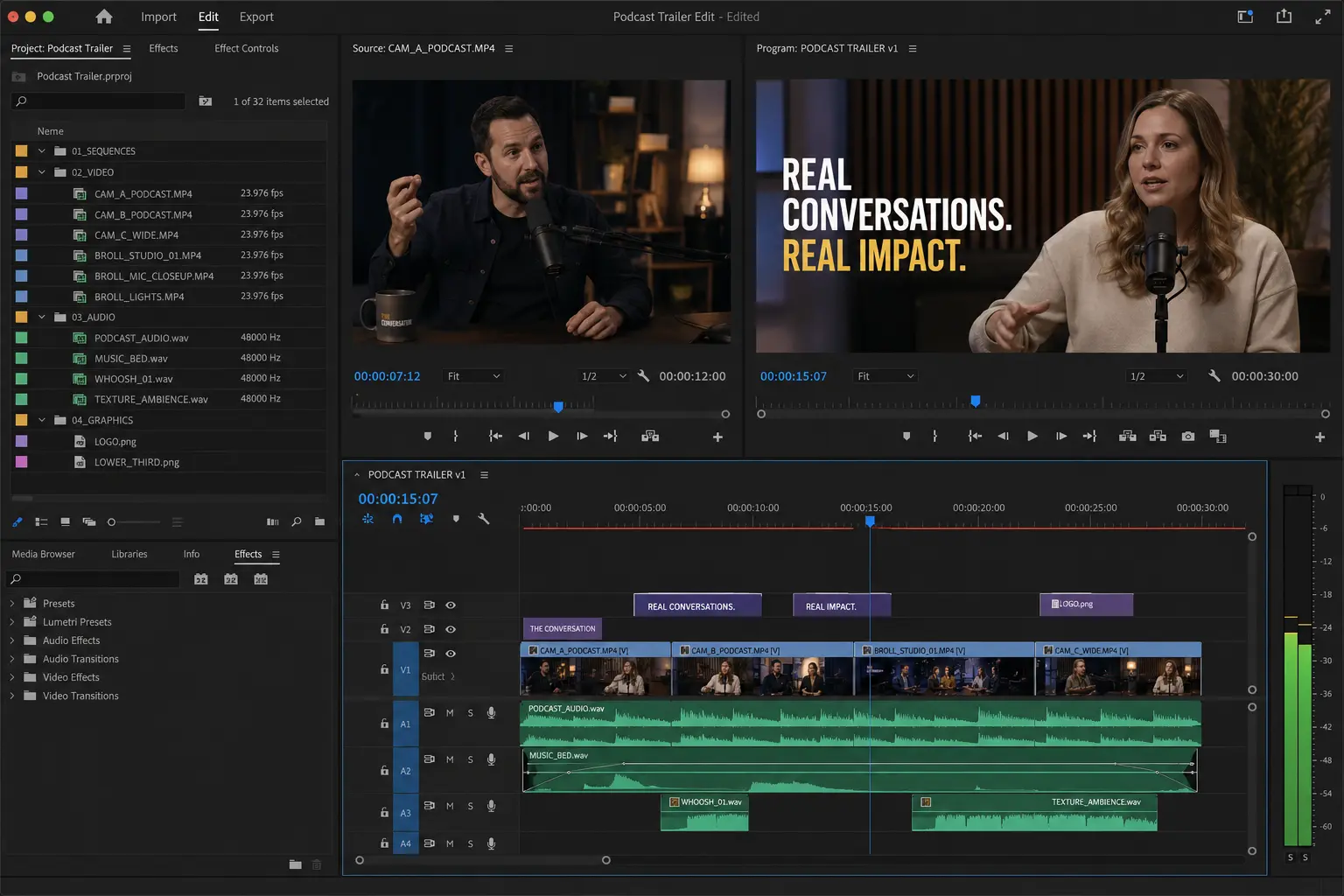
You just finished recording a great episode.
Good guest. Real conversation. An hour and a half of things worth hearing.
You upload it to YouTube. You share the link. You wait three days.
180 views.
Here is what happened — and it has nothing to do with the quality of your content.
Most people will not click on a 90-minute video from someone they do not already follow. It does not matter how good the thumbnail is. A 90-minute commitment from a stranger is an enormous ask.
But a 45-second clip?
That is not a commitment. That is an offer. Watch this one moment. If it is good, there is more where it came from.
This is the most important thing to understand about how podcasts grow in 2026. The episode is your product. The clips are how new people find it. And the creators who grow fastest are not the ones with the best episodes — they are the ones who publish the most clip doors for new listeners to walk through.
A single episode chopped into 10 clips gives you 10x more opportunities to land on For You Pages and Explore feeds. The episode is not competing with other podcasts. It is competing with everything on the internet for a stranger’s 45 seconds of attention.
This guide gives you everything. How to find the right clips. How many to make. How to brief your editor so the whole process takes minutes, not hours. And why the number most creators think is enough is far less than what the best in the world actually publish.
How Many Clips Should You Make From One Podcast Episode?
Most guides tell you 3 to 6 clips per episode. That is wrong — or at least incomplete.
Here is the real picture.
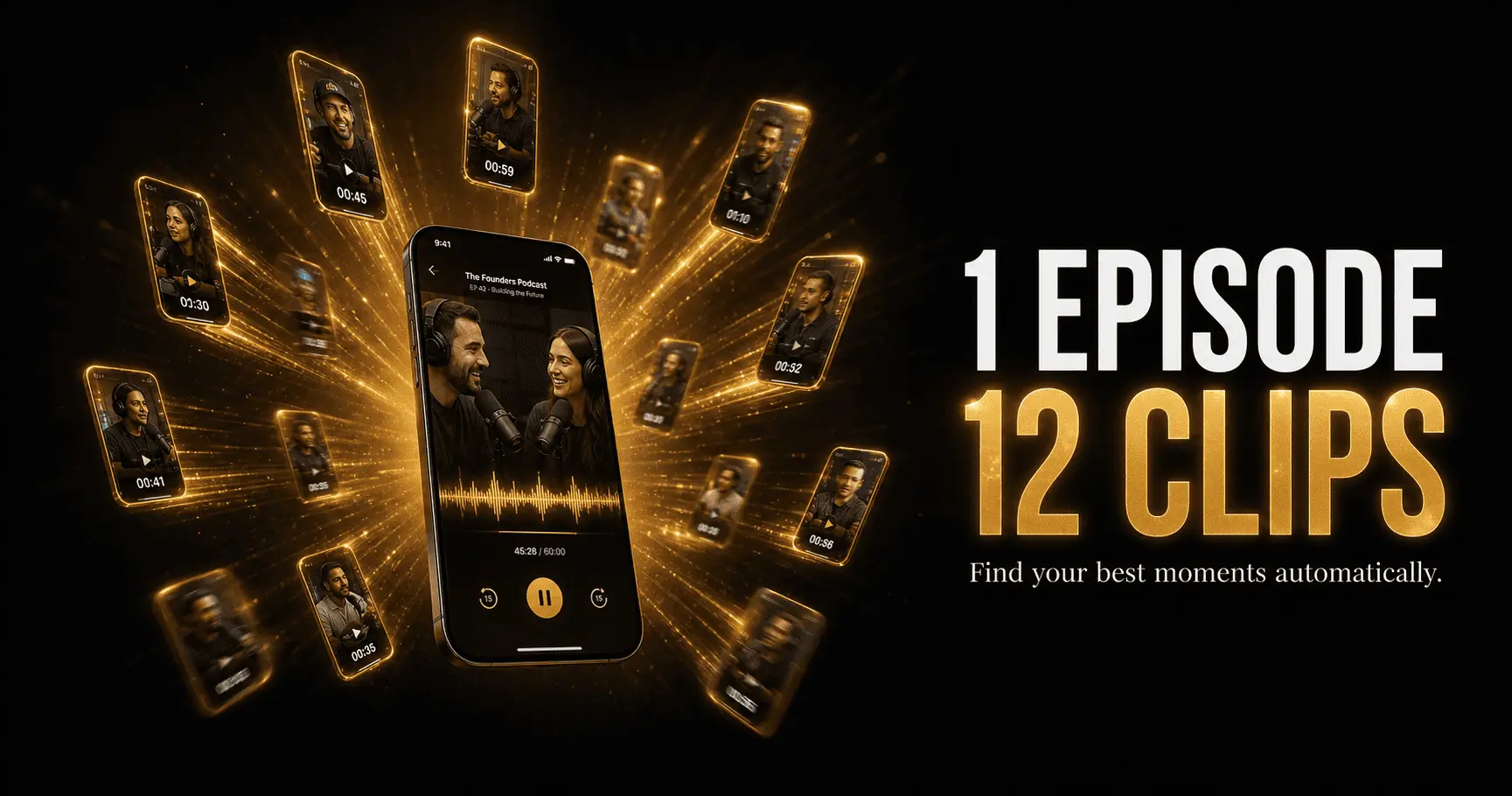
For a 90-minute episode, you should be finding 10 to 12 clips. That is the minimum standard if you want consistent daily posting. For a 2-hour episode with a strong guest, 15 is achievable.
Here is the problem: most creators stop looking too early. They find 4 clips, feel satisfied, and move on. The other 8 are still sitting in the transcript, uncut and undiscovered.
The best podcasters in the world operate on a completely different scale.
A single 20-minute YouTube video can become 8 to 10 TikToks, 8 to 10 Instagram Reels, and 5 to 7 YouTube Shorts. For a 90-minute episode, the math is proportionally larger.
Ranveer Allahbadia’s team publishes 5 to 6 clips every single day across platforms. That is not from multiple episodes — it is from one episode, spread across the week. Nikhil Kamath, Ankur Warikoo, Gary Vee, and Lex Fridman all operate on similar clip frequencies, some posting 15 to 25 clips per episode across all their channels and social handles.
Here is the posting rhythm that works:
From one 90-minute episode, aim for at least 2 clips per day across platforms for a full week. That means 10 to 14 clips total — and some creators with larger teams or ghost channels push this to 20 or more.
The reason: platforms like YouTube Shorts, TikTok, and Instagram Reels reward snackable video, and a single episode can produce dozens of clips that extend reach and discovery. Each clip is a separate lottery ticket in the algorithm. The more you post, the more chances you have to be found.
Why Most Podcast Clips Never Get Views
Before you learn how to find good clips, you need to understand why most clips fail.
It is not editing quality. It is not the platform. It is the selection filter.
Most creators pick clips based on what they loved while recording. The exchange that felt exciting. The line they knew was good as it came out. The moment the guest said something that made the room laugh.
Those moments are meaningful — to you, to your guest, and to your existing audience who already know the show.
But a clip is not for people who already know you.
A clip is for a stranger who has never heard of your show, is watching with the sound off, and has about 2 seconds before they scroll to the next thing.
Here is the one test that changes how you pick every clip from now on:
Does this moment make complete sense to someone with zero context about your show, your guest, or the conversation that led up to it?
If the answer is no — if it needs setup, prior knowledge, or a “you had to be there” — it is not a clip for new audiences.
The best clips work like this: a stranger lands on them cold, gets something complete and valuable in under 60 seconds, and walks away feeling like watching was worth it. That combination is what produces saves, shares, and follows.
Here is the real problem with most podcast clips:
They are made for fans. The clips that grow channels are made for strangers.
The 4 Types of Moments That Perform Best as Podcast Clips
Every high-performing podcast clip falls into one of 4 types.
Once you know these, you will never stare at a transcript wondering what to pick.
Type 1: The Strong Opinion
A direct, confident statement that takes a clear position — the kind of statement that makes a viewer either nod hard or want to push back immediately.
Strong opinions work because they produce an instant, involuntary reaction. When someone feels strongly about something they just watched, they stop. And stopping is the only thing that matters in a scroll-first world.
Ankur Warikoo built his short-form following largely on this clip type. When he says something direct about money, career, or relationships — something that takes a side — those clips spread far beyond his existing audience because they make people feel something immediately.
The same pattern runs through Nikhil Kamath’s short-form strategy. The clips that travel furthest from his show are almost never the summaries. They are the moments where he or a guest states a conviction — something clear enough to agree or disagree with in the first 5 seconds.
Internationally, Dax Shepard’s Armchair Expert built a massive clip following on exactly this pattern. Strong positions on parenting, recovery, and relationships — stated plainly, without hedging — made individual clips shareable to people who had never heard the full episode.
What to look for: any moment where the speaker follows a phrase like “The truth is…” or “Most people get this wrong…” or “I genuinely believe…” Those phrases almost always precede a Type 1 moment.
What kills it: an opinion that builds up to its point. The opinion must be in the first 5 seconds, not revealed after 3 sentences of setup.
Type 2: The Counter-Intuitive Stat
A specific number that breaks what the viewer already assumes to be true.
Here is the psychology: a number that confirms what someone already believes gets processed and discarded. A number that contradicts their assumption makes them pause, re-read, and want to understand why.
The pause is the clip.
Varun Mayya does this consistently. When he drops a specific number about how careers or industries actually work — something that contradicts the common belief — those clips stop people who would otherwise scroll right past. The number is the hook. The explanation is what they stay for.
The most shared podcast content consistently follows this pattern — a data point that breaks expectation, followed by the explanation that reframes how the viewer thinks about something.
Morgan Housel, whose writing and podcast appearances have reached tens of millions of readers and listeners, built much of his following on financial stats that feel wrong at first. That feeling of “wait, that cannot be right” is what keeps people watching to the end of the clip.
The rule: the stat leads the clip. State the number in the first 5 seconds. The explanation follows. Never bury the number after three sentences of context — by then, half the audience has already scrolled on.
Type 3: The Story Peak
The single highest-tension moment inside a personal story — not the full story.
This is where most creators make the same mistake: they clip the entire story. Setup, conflict, resolution, three minutes total. It works beautifully as podcast content — the pacing, the buildup, the payoff. But it does not work as a Reel, because a stranger does not have the context to care about the setup.
The clip is the peak — the one sentence inside the story where the emotion or the insight hits the hardest.
Raj Shamani’s team understands this. The clips that spread furthest from his interviews are never the complete anecdotes. They are the single moment inside the story — the line that hits hard enough to stand alone. When a founder describes the exact second they thought everything was over, that sentence is the clip. Not the four minutes around it.
Alex Hormozi — one of the most-clipped podcast guests globally — produces viral clips for the same reason. His team does not clip the full story of being broke while running three gyms. They clip the sentence: “I had $46 in my account and three payrolls due on Friday.” That line, standing alone with no other context, is the clip.
To find the peak in your transcript: scan the story and ask which single sentence would hit a stranger the hardest with no other information. That sentence is the clip. Add 8 to 10 seconds of setup at the start if needed. The peak carries everything else.
Type 4: The Direct Advice Moment
A specific, immediately usable tip that the viewer can act on before the clip ends.
This type performs consistently on every platform because it gives something the viewer can use today. No course needed. No follow-up required. Watch, understand, act.
Tim Ferriss built a significant portion of his short-form distribution on this exact pattern. The clips that spread from his long-form interviews are almost always the moments when a guest gives a specific, numbered, actionable protocol — something concrete enough to try before the week is out. The specificity is the value.
Varun Mayya and Nithya Shanti both use this pattern for their respective audiences — business and mindfulness. When the advice is specific enough to act on immediately, it gets saved. Saves are the highest-value signal on most platforms, and direct advice clips earn them more consistently than any other type.
The difference between a good Type 4 clip and a weak one: specificity. “Post consistently” is not direct advice. “Post 2 clips per day from your episode, starting 24 hours after the episode goes live, and continue for 7 days” is direct advice. The more specific, the stronger the clip.
What to look for: any moment where a guest says “Here is exactly what I do…” or “The specific thing that changed this for me was…” or “Try this once and see what happens.”
How to Find These Moments in Any Episode — Step by Step
Here is the exact process. Every step matters.
Step 1: Read the transcript. Do not re-watch.
Every recording platform generates a transcript. A 90-minute episode takes about 20 minutes to read. You are looking for moments that make you stop — not because they are funny or familiar, but because a complete idea lands in 1 to 3 sentences. Mark every one of them without filtering yet.
Step 2: Match each marked moment to one of the 4 types.
Go through your marked sections and categorise each one. Type 1, 2, 3, or 4. If a moment does not fit cleanly into any of the 4 categories, move on. If it fits two categories, it is likely a strong clip — keep it and mark both types.
Step 3: Apply the stranger test.
For each remaining moment, read only that section — no surrounding context. Does it make complete sense to someone who has never heard of your show? If yes, keep it. If no, can 8 to 10 seconds of setup make it work? If yes, note the setup line. If it still does not work standalone, discard it.
Step 4: Check the duration.
A strong Instagram Reel runs 30 to 60 seconds. A YouTube Short performs best at 45 to 59 seconds. A TikTok clip in the 21 to 34 second range sees the highest completion rates. If your moment runs longer than 90 seconds, find the peak inside it and trim to that.
Step 5: Write a clip brief for your editor.
This is the step most creators skip — and it costs them hours every week.
A complete clip brief tells your editor five things: the exact timestamp, the clip type, the opening setup line to add at the start if needed, caption notes, and which platform it is going to. Without this brief, your editor makes guesses. With it, each Reel takes 20 minutes instead of 90.
How to Go From 10 Clips to a Full Week of Daily Content
Ten to twelve clips from one episode sounds like a lot. Here is how it maps to a real posting schedule.
Posting 2 clips per day — TikTok in the morning, Reels in the evening — gives you a full week of daily content from a single episode. That is the baseline. Some creators push to 3 or 4 clips per day across all platforms combined.
Here is a practical 7-day distribution from a 90-minute episode with 12 clips:
Day 1 (episode release day): Post the single strongest clip — typically a Type 1 or Type 3 — on all platforms simultaneously. This is your anchor post tied to the episode launch.
Days 2 through 7: Post 2 clips per day across your most active platforms. Alternate clip types to keep the feed varied. Do not post two counter-intuitive stats back to back. Do not post three opinions in a row. Alternate between the 4 types to keep the content feeling fresh.
One important rule about clip spacing: do not post the same clip on two different platforms on the same day unless you are actively trying to drive cross-platform comparison data. The algorithm on each platform rewards content that feels native and original to that platform.
Some creators — particularly those with larger budgets or dedicated teams — run ghost channels and affiliate accounts that distribute additional clips. A single episode can generate 20 to 25 pieces of short-form content across a primary channel, a clips channel, and platform-specific handles. This is the model used by the top 1% of podcast creators, and it explains the volume numbers that seem impossible at first glance.
You do not need to start there. Start with 2 clips per day from one episode. That alone puts you ahead of 90% of podcasters who post the full episode and nothing else.
The Clip That Gets Views vs. The Clip That Grows Your Channel
Here is a distinction that most clip guides miss entirely.
A clip that gets views delivers a complete, satisfying answer. The viewer watches, gets what they came for, and scrolls on. Nothing pulls them toward your full episode.
A clip that grows your channel delivers real value AND creates a question the viewer can only answer by going to the full episode.
The difference is the open loop.
When Nikhil Kamath’s team picks clips, the ones that drive the most traffic back to the full episode are not the summaries. They are the moments where he or a guest makes a claim that you immediately want to hear argued out in full. The clip gives you the thesis. The episode gives you the proof.
Lex Fridman’s team operates on the same principle. The clip gives you the extraordinary statement. The 3-hour episode gives you the conversation that built it. The clip is the door. The episode is the room.
Here is the practical test: after you read a clip candidate in your transcript, ask yourself — does this answer the viewer’s question completely, or does it make them curious about something the episode explains? If it answers completely, it is a good clip but a weak growth driver. If it creates curiosity, it is both.
When two equally strong clips are available, always choose the one that creates an open loop.
[VISUAL: Two phone screens. Left: “Good clip — delivers the answer, viewer satisfied and scrolls on.” Right: “Growth clip — delivers the point, viewer wants the full conversation.” Simple illustration, minimal design.]
Why This Matters More Than Anything Else You Do for Podcast Growth
When people encounter short clips, they often trace them back to the full episode, creating a content funnel that drives sustained awareness.
This is the most important sentence in any guide about podcast growth in 2026.
The full episode does not discover itself. It relies on people actively searching for it or already knowing to look. Clips remove both requirements. A clip can reach someone who does not know your show exists, deliver something valuable in 45 seconds, and send them to the full episode — all without any action from you after the initial post.
Short clips for TikTok, Instagram Reels, and YouTube Shorts feed algorithm preferences for short-form content AND drive traffic back to full episodes. Multi-format content is not just trendy — it is strategic.
The creators who have understood this earliest are the ones with the largest audiences today. Ranveer Allahbadia, Nikhil Kamath, and Ankur Warikoo in India. Gary Vee, Tim Ferriss, and Andrew Huberman internationally. All of them post long-form less frequently than they post clips. The clips are not secondary content — they are the primary distribution engine.
Every episode you record now has two jobs. The first is the episode — the long-form product for people who already trust you. The second is the 10 to 12 clips that introduce you to everyone who does not know you yet.
Both jobs matter. Only one of them grows the room.
PostFlo’s Clip Brief engine handles this automatically. Paste your episode’s YouTube URL and PostFlo reads the full spoken content, identifies every moment that fits the 4 types, scores each one for standalone clarity and short-form potential, and delivers a complete clip brief — with exact timestamps, clip duration, platform recommendation, and the reason each moment works. It processes episodes in English, Hindi, Tamil, and Telugu, and produces a brief your editor can start from immediately.
PostFlo finds your episode’s best clips and builds your editor’s brief automatically. Try it free at postflo.in
Frequently Asked Questions
How do you find the best clips from a podcast episode? Read the transcript and look for 4 types of moments: strong opinions, counter-intuitive stats, story peaks, and direct advice moments. For each candidate, apply the stranger test — does it make complete sense to someone who has never heard of your show? If yes, it is a clip. If no, discard it or add a short setup line to make it work standalone.
How many clips should I make from a 90-minute podcast episode? A 90-minute episode should produce 10 to 12 clips at minimum. This gives you enough material for 2 clips per day across platforms for a full week. Creators with larger teams or multiple channels regularly produce 15 to 20 clips from a single 90-minute episode.
How often should I post podcast clips? The minimum effective frequency is 2 clips per day. The top-performing podcast creators post 5 to 6 clips per day across all their platforms combined. Start with 2 per day from one episode and spread them across the full week — do not post everything on episode release day.
What length should podcast clips be for Instagram Reels, YouTube Shorts, and TikTok? For Instagram Reels, 30 to 60 seconds performs best. For YouTube Shorts, 45 to 59 seconds sees the strongest completion rates. For TikTok, 21 to 34 seconds is the sweet spot. Clips under 20 seconds rarely give enough time to deliver a complete idea. Clips over 90 seconds should only go on LinkedIn or as standalone YouTube videos.
Do podcast clips need captions? Yes, and this is not optional. Over 80% of social media video is watched without sound on mobile. Without captions, most viewers receive nothing from your clip regardless of how good the content is. For Hindi, Tamil, and Telugu creators, captions in the native script consistently outperform romanised text or English subtitles in saves and shares.
What is a podcast clip brief and why does it matter? A clip brief is a written document you give your editor before they start cutting. It contains 5 things: the exact timestamp, the clip type, any opening setup line to add at the start, caption style, and which platform the clip is going to. Without a brief, your editor makes guesses that send them back to you with questions. With a brief, each clip takes 20 minutes to produce instead of 90.
How do I get viewers to watch the full episode after seeing a clip? End the clip at the peak — not at the resolution. The clip should deliver real value but create a question the viewer can only answer by going to the full episode. Add a text overlay: “Full episode in bio” or “Link in comments.” In the caption, mention one specific thing the full episode covers that the clip did not. The goal is curiosity, not satisfaction.