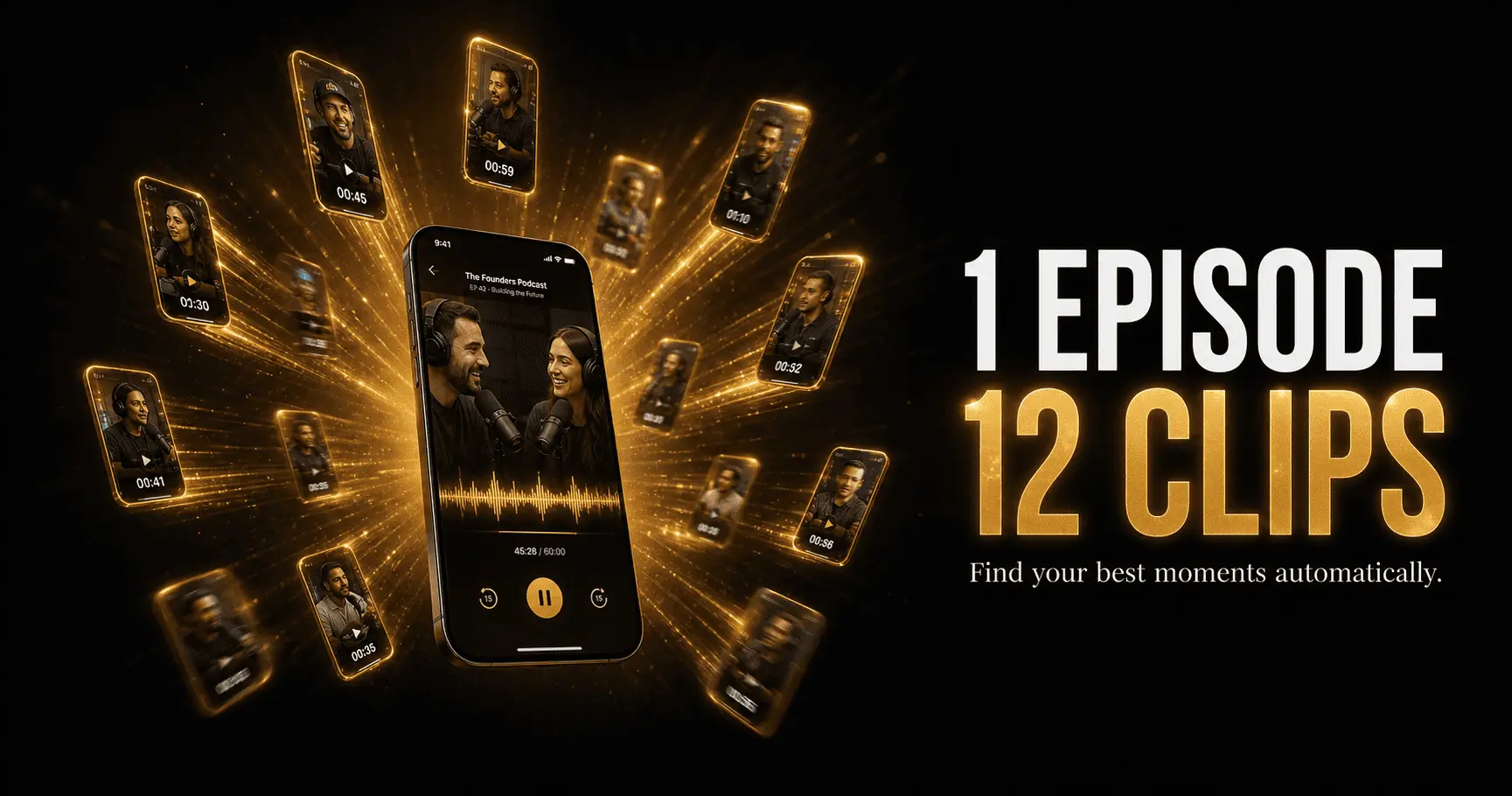
Most podcast creators make the same trailer mistake.
They pick the 4-5 most intense moments from the episode. String them together. Add music. Post it.
The result: a 60-second highlight reel that gets likes on Instagram but does not drive episode views.
The viewer watches the trailer, gets the best parts, feels satisfied, and scrolls past the full episode.
You gave away the payoff for free.
The Difference Between a Highlight Reel and a Trailer
A highlight reel says: “Here are the best moments from this episode.”
A trailer says: “Here is why you need 90 minutes of this.”
One satisfies. The other creates hunger.
The difference is not editing quality. It is moment selection. Which moments you pick, how much you reveal, and where you cut determines whether the viewer feels complete or incomplete after watching.
A viewer who feels complete has no reason to click the full episode.
A viewer who feels incomplete needs to.
Why Your Brain Clicks on Some Trailers and Ignores Others
There is a reason movie trailers work differently from movie recaps.
The brain has a built-in need to close open questions. Psychologists call this the Zeigarnik effect. When you hear something unresolved — a story that stops mid-sentence, a question without an answer, a conflict without a resolution — your brain locks onto it. It stays in working memory until the loop closes.
A highlight reel closes every loop it opens. The viewer hears the setup AND the punchline. The tension AND the resolution. The question AND the answer.
A trailer opens loops without closing them. The viewer hears the setup but not the resolution. The tension but not the release. The question but not the answer.
That is why the viewer clicks. Not because the content was good. Because their brain needs the answer.
Three Rules That Separate Trailers From Spoiler Reels
We studied trailer structures across hundreds of podcast episodes processed through Postflo. The trailers that drove full-episode clicks shared three patterns.
Rule 1: Open Questions, Zero Answers
Count the questions your trailer opens. Then count how many it answers.
The answer count should be zero.
If a guest says something shocking in the trailer and you also include the explanation, you closed the loop. The viewer got what they needed. No click.
If you show the shock without the explanation, the loop stays open. The viewer needs the full episode to close it.
For a 60-second trailer, aim for 3-4 open questions. Each moment should make the viewer think “wait, what happened?” or “why would they say that?” — and then cut away before the answer arrives.
Rule 2: Hide the Peak Moment
This one goes against every instinct.
Most creators find the single most intense moment in the episode and build the trailer around it. The biggest laugh. The most emotional confession. The most controversial take.
Do not put it in the trailer.
The peak moment is your episode’s strongest asset. It is the reason someone will remember the episode and come back next week. When you put it in a 60-second trailer, you turn a 90-minute experience into a 60-second one.
Instead, tease around the peak. Show the setup. The reaction. The silence before. The facial expression right after. Let the viewer feel that something massive happened without seeing what it was.
The peak moment is the full episode’s job to deliver. Not the trailer’s.
Rule 3: Move Through at Least Two Emotional Registers
A trailer that stays at the same energy for 60 seconds is forgettable.
Even if that energy is high.
The brain does not remember states. It remembers transitions. A shift from laughter to dead silence in 3 seconds is more memorable than 30 seconds of consistently high energy.
Your trailer should move through at least two emotional registers. Quiet to intense. Funny to vulnerable. Confident to uncertain.
The shift itself is what the viewer remembers. Not the intensity.
Strong pattern for a 60-90 second podcast trailer:
- Quiet, specific revelation (5-10 seconds)
- Energy spike — confrontation, surprise, or humor (10-15 seconds)
- Tonal shift — warmth, vulnerability, or an unexpected quiet moment (10-15 seconds)
- Cliffhanger — the biggest unresolved question, cut mid-sentence or mid-reaction (5-10 seconds)
The Selection Problem: Why “Just Pick the Best Parts” Does Not Work
Here is the practical problem.
A 90-minute podcast episode has 40-60 potential trailer moments. Emotional peaks, surprising reveals, funny exchanges, tense confrontations.
The creator or editor watches the full episode and picks the ones that feel strongest. That is intuitive. It is also wrong.
Because the moments that FEEL strongest when you know the full context are not the same moments that CREATE HUNGER when shown in isolation.
A moment that feels incredible because you understand the 20 minutes of buildup before it — that moment falls flat in a 60-second trailer where the buildup does not exist.
The right trailer moments are the ones that work WITHOUT context. Moments where a stranger who has never heard of your show watches 10 seconds and thinks: “I need to know what this is about.”
That is a different selection criterion than “best moment.” It is “most incomplete moment.”
What Postflo’s Trailer Engine Does Differently
Postflo reads the full episode transcript before generating the trailer brief. Not a skim. The full transcript.
Then it evaluates every potential moment against three criteria:
1. Does this moment open an unresolved question? If the moment contains both the question and the answer, it gets filtered out. The trailer needs moments that create hunger, not moments that satisfy it.
2. Does this moment create emotional contrast with the moments around it? If three consecutive trailer moments all have the same energy (all hype, all serious, all funny), the engine flags it. The trailer needs tonal movement.
3. Does this moment leave the viewer needing more? If the moment resolves completely — a joke with a punchline, a story with an ending, a question with an answer — it gets replaced with a moment that cuts before resolution.
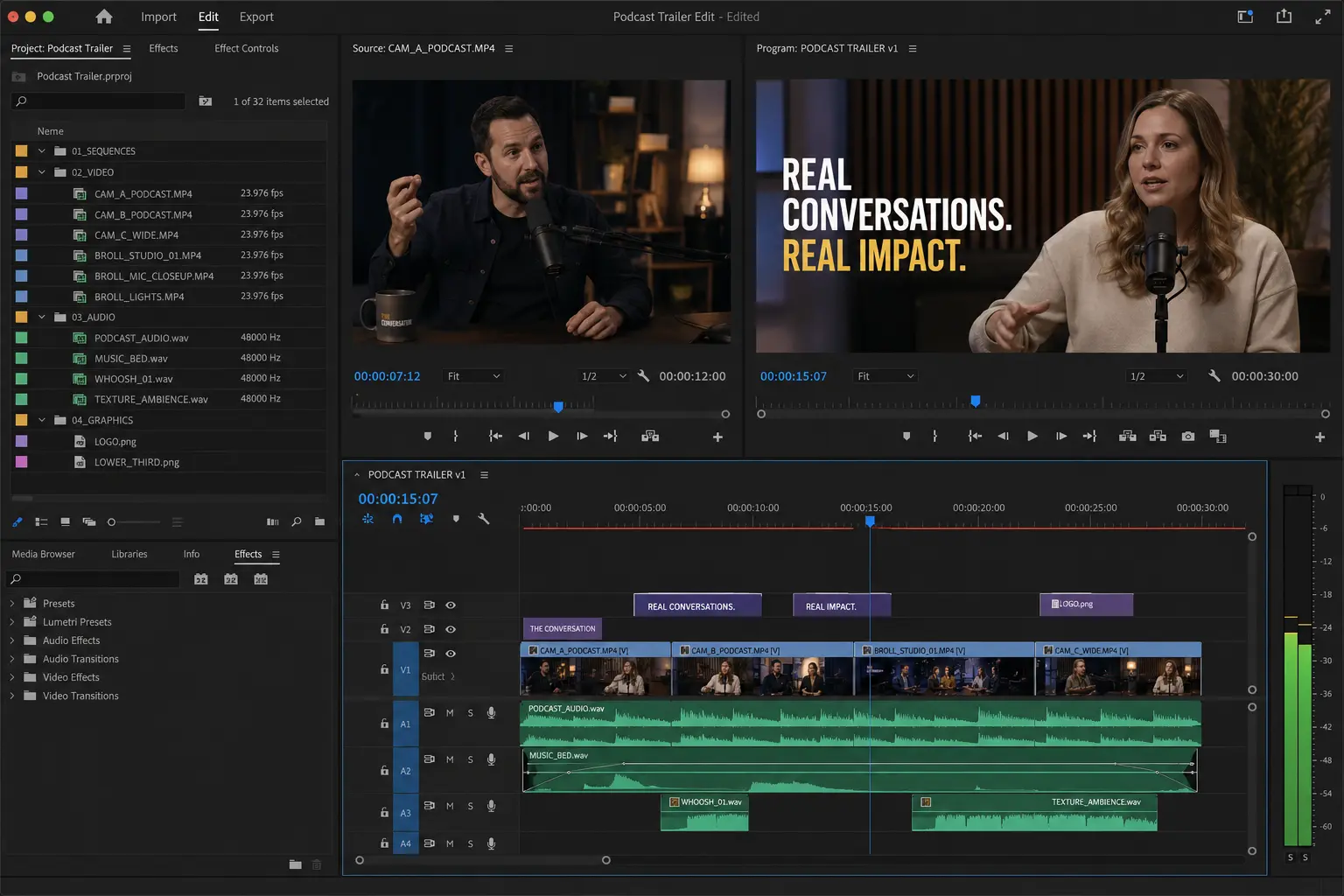
The output is a shot-by-shot brief. Exact timestamps. Spoken hook for the opening. Where to cut in. Where to cut out. What the viewer should feel at each transition.
Your editor gets a brief they can cut in 20 minutes. No guesswork. No “just pick the best parts.”
The Trailer Is Not Content. It Is a Contract.
This is the shift that changes everything.
Stop thinking of the trailer as content. It is not.
The trailer is a contract between the creator and the viewer. It says: “Here are 4 moments that prove this episode is worth 90 minutes of your time. Stay, and you will get the full version.”
Each moment in the trailer is a promise. Not a delivery.
The full episode delivers. The trailer promises.
When your trailer delivers instead of promises, it replaces the need for the full episode. That is why views on the trailer go up but views on the full episode stay flat.
When your trailer promises without delivering, every trailer view becomes a potential full-episode view. Because the viewer cannot get what they want from the trailer alone.
How to Evaluate Your Current Trailer
Watch your latest trailer and answer three questions:
Question 1: After watching the trailer, do you already know what happened in the episode? If yes, the trailer is a spoiler reel. You gave away the story.
Question 2: Does the trailer stay at the same emotional energy throughout? If yes, the trailer is flat. The viewer’s brain will not distinguish it from the 20 other trailers they scrolled past today.
Question 3: Does the trailer make you want to watch the full episode, or does it feel complete on its own? If it feels complete, it is working against you. A good trailer should feel deliberately incomplete.
If your trailer fails any of these three, the problem is not your editor. It is your moment selection.
The Bottom Line
Your trailer is the single highest-leverage piece of content you produce per episode.
It appears in feeds, stories, reels, and shorts. It reaches people who have never heard of your show. It is the audition for the full episode.
And most creators waste it on a highlight reel.
Open loops instead of closing them. Hide the peak instead of giving it away. Move through emotions instead of staying flat.
That is the difference between a trailer that gets likes and a trailer that grows your show.
Postflo generates shot-by-shot trailer briefs for podcast creators across Telugu, Hindi, Tamil, and English. The engine reads your full transcript and selects moments that create hunger, not satisfaction.
Try it at https://postflo.in